The past six months have brought significant change across the software landscape, reshaping the opportunities and dynamics within HRTech. Through our work with founders, investors, and acquirers, we’ve been exploring two central questions: How are HRTech providers creating and capturing value, and where are investors and acquirers seeing the greatest opportunities?
Conversations at this year’s HR Tech conference highlighted three characteristics that standout from an investment perspective: mission-critical workflows, vertical specialization, and customer retention. Together, they provide a framework for assessing whether a provider can defend its place in the budget, differentiate from broader platforms, and sustain recurring revenue. For M&A, the same lens helps distinguish acquisitions that deepen a platform’s role within its customers from those that simply add features.
Many providers are working to become more essential by extending into operational workflows, tailoring solutions to specific industries, and demonstrating measurable outcomes. The investment question is whether those efforts translate into deeper adoption and stronger customer retention - not just a broader product story. The following three conference takeaways illustrate how providers are responding and what investors and acquirers should evaluate.
Employee engagement, rewards, recognition, and retention are important business priorities in their own right. For providers, the challenge is to make their contribution to those priorities clear and measurable. Some are also extending their solutions into adjacent workflows, broadening the value they deliver and the stakeholders they serve.
A few examples came up in our conference conversations:
These extensions do not replace the core value of engagement, recognition, or the employee experience. They build on it. The distinction is important: this is not simply relabeling an HR product to reach another budget. The product needs to deliver meaningful value in each use case it serves. We are seeing providers gain traction and investor interest by embedding their solutions in mission-critical functions or tailoring them to the specific needs of frontline industries such as healthcare and manufacturing. For investors and acquirers, the diligence question is whether that specialization produces deeper workflow integration, measurable customer value, and stronger customer retention. Serving an essential industry alone does not make a product essential.
Another recurring theme was the gap between having access to AI and knowing how to use it effectively. This presents an interesting opportunity for HR to spearhead organizational AI objectives. The dynamic at play is employees have a wave of AI tools available to them but little guidance on how to practically implement them into their day-to-day work.
That creates an opportunity for learning, change management, and workforce providers to move beyond general AI awareness toward practical, role-specific enablement. For us, the more compelling approach starts with an employee’s actual workflow. A recruiter, frontline manager, and finance professional do not need identical training. They need guidance that connects the available tools to the irresponsibilities, with clear boundaries and opportunities to practice.
This ties back to our first theme: workforce solutions can address priorities shared across HR, IT, and business leaders. In this case, the opportunity is not simply to educate employees on AI, but to help them apply it effectively in their work.
We also noticed a striking duality in how workforce technology companies talk about AI. Some are leaning fully into agentic AI, putting autonomous agents and redesigned workflows at the center of their story. Others are putting less emphasis on the terminology and more on what the product actually does.
The contrast brought to mind the latest Salesforce ad featuring F1 Driver Daniel Ricciardo where he closes with: “Welcome to the Agentic Enterprise,” followed by Daniel admitting, “I have no idea what that means, but I like it.” The quip captures a real workforce dynamic: enthusiasm is not the same as understanding or adoption.
For a workforce buyer, “hire faster” or “personalize learning” provides a clearer starting point than an AI label alone.
These approaches are not necessarily in conflict. Providers can have an ambitious technology vision while explaining the immediate use case in plain language. The challenge is making sure the vision does not obscure the value.
Our biggest takeaway from HR Tech was not that every provider needs a new category or a bigger AI story. It was that the strongest positioning starts with a recognizable problem that can demonstrably tie back to operational or financial outcomes. Whether the conversation is about safety, frontline retention, employee AI fluency, or faster hiring, the test is similar: Who owns the problem, why does it matter, and what gets better when the solution is implemented?
For HR tech companies, that clarity can help turn an interesting product into an essential part of the customer’s operations. For investors and acquirers, the task is to test that positioning against customer retention, usage, and evidence of measurable value. Those are the foundations for underwriting durable growth and identifying acquisitions that strengthen a platform’s customer relationships and competitive position.
At Harbor View Advisors, we work with technology and services businesses navigating growth and M&A. We’re always glad to connect with the founders, executives, and investors shaping the workforce technology market.
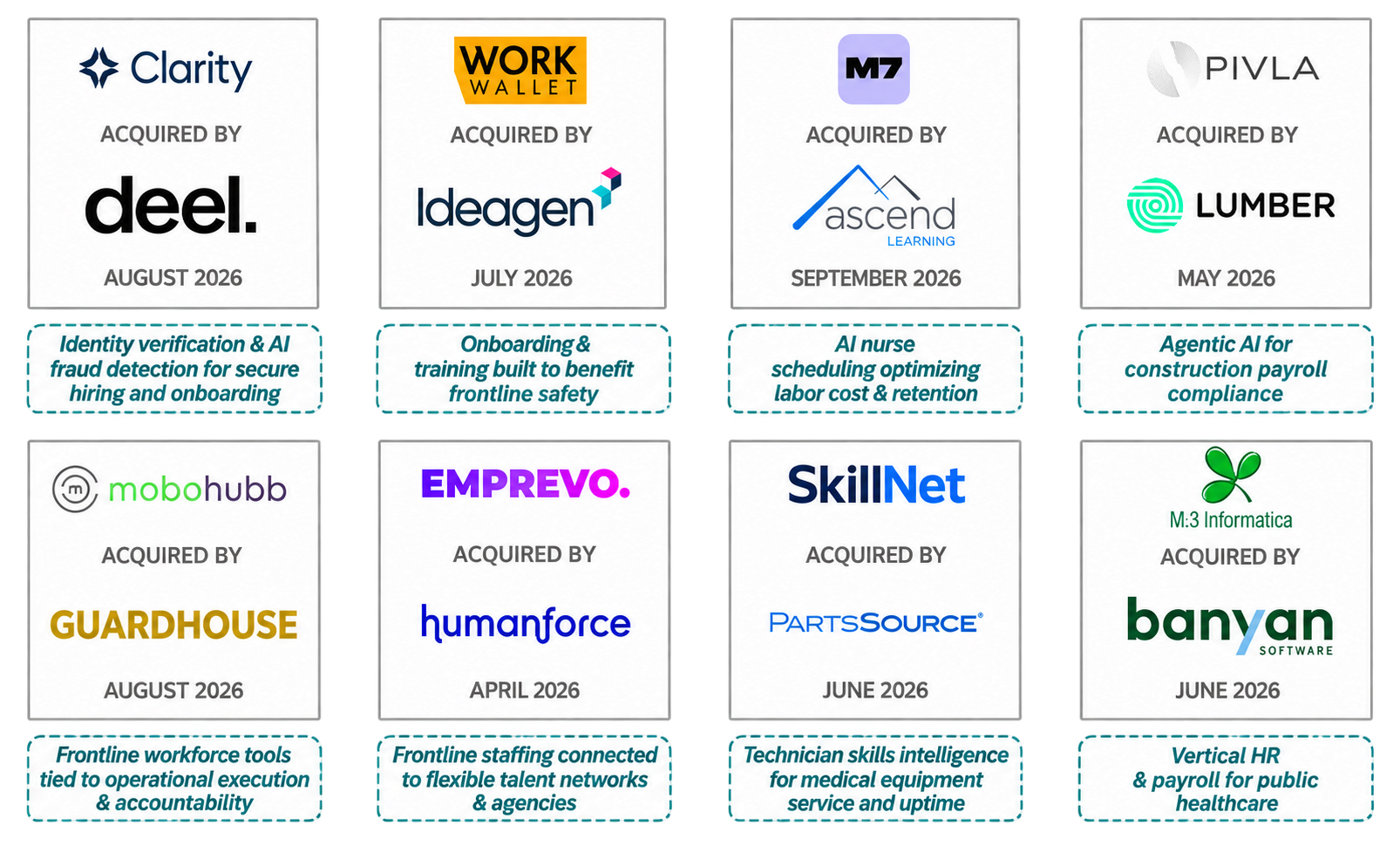
Explore Recent HCM Acquisitions That Illustrate These Trends Below